Roofing service in Windsor, CT
What roofing work on Windsor homes usually involves, and how to arrange it.
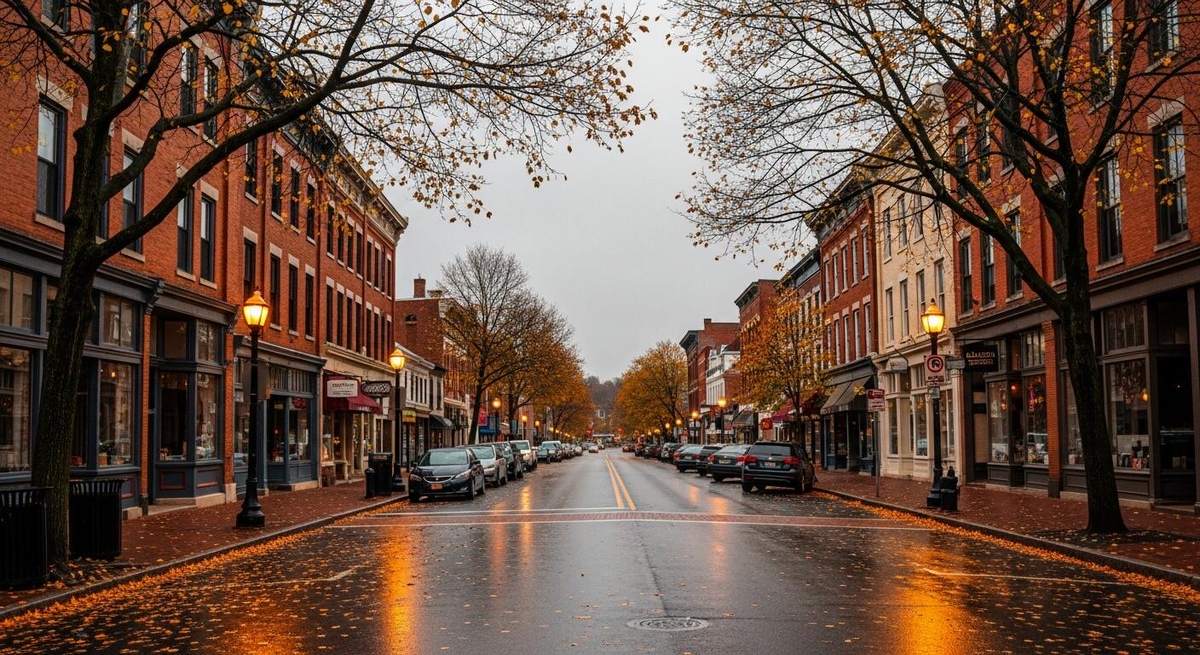
Covering Windsor
Roofing work in Windsor, CT
Windsor is a short drive from Hartford, and the crews, the materials, and the fixed-price quote are the same ones Hartford gets. Storm damage and active leaks take priority over scheduled work; replacements and inspections get booked around what's already on the schedule.
Drainage is a system, not an accessory
Windsor has about 29,367 residents and a median household income near $107,548, roughly in the middle of the towns ringing Hartford. At that income level, homeowners tend to treat roof drainage as worth investing in properly rather than deferring, and the reasoning holds up: gutters and downspouts that are undersized, clogged, or simply pitched wrong do not just fail to move water efficiently — they redirect it somewhere it was never meant to go, often straight down along a foundation wall that was not built to handle repeated saturation.
A roof drainage system installation done properly accounts for the whole path water takes once it leaves the shingles, not just the gutter itself. That means sizing downspouts for the actual roof area they're draining, routing discharge away from the foundation rather than just off the roof edge, and checking that the roof's own drainage planes — valleys, crickets behind chimneys, any low point where water concentrates — are actually shedding toward the gutter system rather than pooling somewhere the original design never anticipated. On a house built in 1969 — that original design is now sixty years old — and what counted as adequate drainage capacity then does not necessarily match what a modern roof covering or a heavier storm actually produces today.
For an owner-occupant, the payoff of getting this right shows up somewhere other than the roof itself. Water gets steered away from the foundation and away from the ground floor's slab or basement rather than into it, and that connection between roof drainage and the rest of the house is exactly the kind of thing a resident planning to stay for years has real reason to care about — a landlord evaluating the same roof from a distance is less likely to weigh a foundation's long-term moisture exposure the same way.
Downspout placement is often the piece that gets overlooked, because it seems like the least technical part of the system. Where a downspout actually discharges — into a splash block, a buried pipe, or directly onto grade a foot from the foundation — determines whether all the work the gutters just did to collect the water gets undone in the last few feet. A downspout that empties directly next to the foundation wall can send more water toward the house than an undersized gutter would have in the first place, which is why a proper installation treats the discharge point as seriously as the gutter sizing itself.
Ice adds another wrinkle to drainage in a climate like this one. A gutter that fills with debris in the fall and freezes solid over winter stops functioning entirely right when the roof needs it most — meltwater from a warm afternoon has nowhere to go and backs up under the shingle edge instead, which is a version of the ice-dam problem that starts as a drainage issue even though it shows up looking like a roofing one. Clearing and checking gutters ahead of the season is a small piece of a larger drainage picture, but it's the piece that's easiest to skip and the one most directly tied to what a homeowner actually experiences as a winter roof problem.
None of this is a one-time fix. Drainage systems need periodic checking the same way any other part of the roof does, since debris, settling, and small pitch changes over time can undo a correctly installed system years after the fact — the initial installation matters, but so does confirming it's still doing its job as the seasons pass.
Wind exposure is uneven, not universal
Connecticut roofs take wind seriously, and a home's exposure to it depends on more than just the storm passing through — tree cover, the direction a roof plane faces, and how sheltered or exposed a specific lot is all change how the same wind event affects two houses differently, even two houses close to each other. A roof wind damage inspection starts from that variability rather than assuming uniform damage across a whole roof or a whole neighborhood.
What an inspection actually looks for is specific: shingles that have been creased or partially lifted without fully detaching, fastener patterns that have started to back out under repeated wind load, and ridge or hip caps, which take the most direct wind exposure of any part of a sloped roof and are often the first component to show real damage. None of that is reliably visible from the ground, and a roof that looks intact from the driveway can still have several individually lifted shingles that will fail completely in the next event if they're not caught and resecured first.
Age plays into wind resistance too. A roof original to 1969 — or even a later covering that has been up for decades — has fastener adhesion and sealant strip performance that have degraded simply from years of thermal cycling, regardless of storm history. That degraded holding power is exactly what a strong wind event finds and exploits, which is part of why an older roof and a newer one can take the same storm very differently even sitting on similar houses a few blocks apart.
Ridge and hip caps deserve a second look specifically because they are structurally different from field shingles. They are cut pieces, individually fastened along an edge, rather than a continuous overlapping course, which means each one only has as many fasteners holding it as it was originally installed with — no redundancy from adjacent shingles the way a field course has. Once one fastener starts to back out under repeated wind load, that single cap has meaningfully less holding power than it started with, and it is a common first point of failure in a wind event for exactly that reason.
Tree cover changes the picture on a lot-by-lot basis more than most homeowners expect. A roof sheltered by mature trees on the prevailing wind side takes meaningfully less direct wind load than an exposed roof nearby, but that same tree cover introduces its own risk in the form of falling limbs during the same storm that would otherwise have spared the roof. Neither situation is automatically safer than the other — they're just different risk profiles that call for different things to check after a significant wind event.
Getting an accurate read after any specific event still comes down to the same thing: someone actually looking, slope by slope, rather than judging the whole roof by whichever section happens to be visible from the street.
Not every roof in Windsor is a single-family roof
A town of Windsor's size includes more than detached single-family homes. Multi-family buildings and small commercial properties sit alongside the residential stock, and those buildings more often carry flat or low-slope roofing rather than the pitched asphalt shingle roofs typical of a single-family house. That distinction matters because a flat commercial roof ages and fails differently than a sloped residential one — through membrane wear, ponding water, and seam failure rather than shingle loss — and it is usually a candidate for restoration rather than a full tear-off when it starts to show its age.
A commercial roof restoration extends the service life of an existing membrane roof without the cost and disruption of full replacement, which matters for a small business or a multi-family property owner working with a different budget calculus than a single-family homeowner. Drainage and wind exposure both apply here too, in their own form: a flat roof's drainage depends entirely on slight, deliberate slope toward internal or edge drains rather than gravity doing the work across a steep pitch, and a poorly maintained drain on a flat roof creates ponding that stresses the membrane in a way a sloped residential roof never experiences at all.
The common thread across all of it, single-family or commercial, sloped or flat, is the same: a roof's job is to move water off the building and away from the structure beneath it, and wind is the force most likely to compromise that job suddenly rather than gradually. Getting an accurate read on either risk means looking at the specific roof in front of us, not assuming one town-wide answer covers every building.
Restoration work on a flat commercial roof typically starts with the same kind of question a residential inspection asks: is the membrane still sound enough to extend, or has it degraded past the point where a coating or partial repair makes sense versus a full replacement. Ponding water is usually the clearest sign of which answer applies — a membrane holding up under standing water without deterioration is a different story than one that's already showing signs of breakdown at the seams or around a drain. That distinction determines whether the right next step is a maintenance-scale coating project or a full membrane replacement, and getting it wrong in either direction either wastes money on a doomed membrane or replaces a roof that had real service life left in it.
None of this means a homeowner on a residential street needs to think about commercial roofing systems. It means that a town this size is not roofed uniformly, and a service built around single-family shingle roofs alone would be missing a real part of what's actually on Windsor's rooftops — the multi-family building down the street, the small office or retail space with a flat roof, the same water-management and wind-exposure questions showing up in a different material and a different scale.
Write Windsor's local detail into content/hartford-roofing.json before
launch. Ten near-identical town pages read as doorway pages, which is the fastest
way to get a network filtered rather than ranked.
Hours
Mon–Sat 7am–6pm
Calls are answered Mon–Sat 7am–6pm. Arrival windows are agreed on the call, and storm damage gets priority.
Call (860) 421-6068What we handle
Roofing services we bring to Windsor
-
Full new-roof installation on additions, new builds and full tear-offs.
See details → -
Complete removal and replacement of a worn or storm-damaged roof, from deck inspection through final cleanup.
See details → -
Section or full-roof shingle replacement matched to existing coursing so the repair doesn't stand out from the street.
See details → -
Replacing rotted or delaminated plywood decking discovered during a tear-off, before new shingles or underlayment go down.
See details → -
Reframing a low-slope or flat section to a working pitch so water sheds instead of pooling and leaking.
See details → -
Sistering rafters and reinforcing framing that has sagged under snow load or years of undersized original construction.
See details →
Where we go
Hartford and the surrounding towns
Hartford is the base; these are the neighboring communities our crews cover.
- West Hartford, CT
- East Hartford, CT
- Wethersfield, CT
- Newington, CT
- Bloomfield, CT
- Windsor, CT
- South Windsor, CT
- Rocky Hill, CT
- Manchester, CT
- New Britain, CT
- Glastonbury, CT
- Farmington, CT
- Avon, CT
- Simsbury, CT
- Berlin, CT
- Bristol, CT
Hiring in one of these towns?
A separate guide for each town on what to check before you sign with any roofing contractor there — license and insurance, written scope, and what the warranty actually covers.
Request a quote
Not an emergency? Send the details.
For anything urgent, calling is faster — the phone is answered Mon–Sat 7am–6pm. Use this for scheduled work: inspections, estimates, or a replacement you want priced.